Our panel of experts ask why delegated consulting is higher up on the agenda than ever before
Chair [Ian Bailey]: We are here today to talk about the outsourcing of day-to-day investment activities from pension fund trustees to either consultants, fund managers or somebody else, sometimes called delegated consultants, sometimes called fiduciary managers or sometimes called other things. Do you think these different names in the marketplace are causing confusion or do people generally understand the concept?
Wyld: There is confusion between the different labels but if you're thinking of it as a battle, I think the term "fiduciary management" is winning. Having said that, I'm not sure that is important. To my mind the more one focuses on what the right term is, the more one starts thinking about this as a product when really it is a service, a very bespoke service which varies from one trustee board to another, from one service provider to another. It's not overly useful to get hung up on what you are actually going to call it.
Docherty: I agree. You could draw a parallel with something like active management and passive management. We all know the differences between the two, but we all know that with active management there are lots of different styles and lots of different ways of doing things, so we understand that it's an umbrella term. I'm not really concerned as to which term wins the battle but I would like to see one win so that we can all coalesce under this umbrella but still be able to differentiate our offerings.
Anthony: I agree there is still some confusion but less so than there was. I like the term 'fiduciary management' because it emphasises the fact that there is a very strong fiduciary responsibility not only on the trustees – which they can't fully delegate away – but also on the part of the delegated consultant/fiduciary manager. I did come up with some alternative terms to include 'delegated investment management', but the acronym for that would be 'DIM', or 'second party asset management' which came out as 'SPAM', and also "consultant led asset management " but that came out as "CLAM" so I'm not sure I am any further forward in actually defining an appropriate term for it!
Joking aside, if we recognise that what we are talking about generally is the delegation of risk allocation; asset allocation in the short to medium term; the construction of portfolios; the ability to deal with short-term market anomalies; and the hiring and firing of managers then I think that probably sums up the main functions.
Service offerings
Chair: Have you seen any differences between people who call themselves delegated consultants, fiduciary managers or other names in terms of the services being offered?
Swynnerton: You definitely see a wide range of services being offered and different levels of responsibilities being delegated, but it's difficult to tie them down to one definition or another. As advisors we can get quite hung up in discussions like this about what the right term should be but from a client's perspective, it's not important. What's important to them is that they understand what service they are getting and that they understand what is being delegated and that can vary from scheme to scheme and provider to provider.
Butcher: That is key. There is still some confusion about what's out there and what's available. The basic principles are sound but the devil is in the detail and I see this as acting as a barrier to the market. If as a trustee you are buying an actuarial service, you know what you are getting. If you decide you like the principle of delegating some of the functionality of investment, there are any number of providers that will do it in any number of different ways. You can't compare apples with apples and that's stopping a lot of clients going down this route.
Chair: Do you see much difference between what the consultants are offering compared to fund managers?
Wyld: I don't think any two offerings are the same, whether we are talking about a consultant, an investment bank, or an asset manager.
Anthony: There probably is a bit of a difference in that the consultants are likely to use a wider range of investment managers, compared to the investment banks which might tend to favour their in-house funds, although some managers offering diversified growth products are are already happy to go outside of their own shop.
Butcher: There are also some consultants though who have formed allegiances with certain fund managers which restricts their fund choice.
Docherty: But on average the consultants don't use in-house funds whereas the investment managers have an incentive to do so. I do agree, though, that you can't classify 'consultants' as being in one bucket and 'investment managers' or 'fiduciary managers' in another bucket; even within the consultants there are different levels of delegation. No two solutions are the same.
Butcher: We are also seeing 'delegated lite' models emerging. Here a consultant can say: "If you don't want the full delegated model as it's too sophisticated or expensive for you, here's an alternative which tries to capture 80 per cent of the benefits."
Docherty: That highlights the importance of choosing the right model – in some cases, for example, partial delegation may not be enough for trustees to meet their governance challenges.
Wyld: Again, aren't we getting bogged down here with definitions? Every single pension fund that I've come across already delegates to an extent, whether it's simply delegating stock-picking decisions to an investment manager. The issue here is about how much to delegate, and I think the more that providers try to sell delegation to trustees – be it full or partial delegation – the more wary they are going to be about it. Ultimately it is going to have to come from the trustees' perspective, in terms of what makes sense for them in the context of their own investment governance model.
Chair: Are trustees on the whole happy to delegate more or are they not really comfortable with going beyond what they've done historically?
Butcher: This is a fairly polarised debate. There are some trustees whose response to that is: "Absolutely not. We are responsible for this pension fund and we're not going to just pass it on to somebody else and give them carte blanche to do whatever they want with it." The fundamental problem – and this is particularly the case with the smaller schemes – is that under the old model, it took far too long for the trustees to make investment decisions. That just doesn't work anymore. What I would like to see is trustees pre-considering their investment triggers, setting their triggers during a discussion with their investment consultant and then somebody (whether it be the delegated consultant or the fiduciary manager) going away and doing it. Then the level of delegation can almost be an authority level. For example you can deal with this up to £10 million, you can deal with this up to £50 million, you can deal with this up to £100 million, and so on.
Market take-up
Chair: We know that there has been a lot of interest in increased delegation, but has this actually translated into much?
Docherty: In our organisation over the last two years we have gone from zero to £3 billion of assets under management in the UK, and US$18 billion globally. That's in a relatively short space of time. We also try to stay close to the market and conduct numerous surveys among clients, pension managers and trustees, and about a fifth of them are regularly saying that they are seriously considering delegating more than they currently do. The consistent message around why is that trustees feel it just takes them too long to make decisions the old way. The decisions are too complex and the trustee timetable doesn't lend itself to making quick decisions.
Swynnerton: We are certainly seeing more clients looking at it, although actual implementation has probably been slower than might have been expected. Part of the reason is a lack of understanding about exactly what is involved and the fact that there are so many models that can be employed. No one size fits all so it is sometimes a difficult concept for trustees to grapple with.
On top of that you have everything else that trustees have to deal with at the moment – huge amounts of complex new legislation and regulation, The Pensions Regulator requirements, big funding and covenant issues and so on. These take up a lot of the trustees' time, although ironically for time-poor trustees, a delegated approach might free up more time to focus on important issues such as these.
Anthony: The implementation of delegated consulting/fiduciary management has also been slow because there's the absence of a track record with most players having only been in the UK market for a short while. Give me a longer track record, say three or five years of track record and that gives a better perspective.
Looking to the future, there is little doubt that there will be fewer and fewer open defined benefit (DB) schemes, which means future provision will be taken care of by defined contribution (DC) schemes, and some on a contract rather than a trust basis. But the legacy arrangements – the preserved DB schemes – will still have to be run by trustees; there will still need to be member nominated trustees and individuals will be less and less inclined to take on the responsibility for their company's pension fund. So there will be a more ready market for delegated consultants/fiduciary managers going forward, and I think their appointment will become more the norm, particularly for smaller schemes.
Butcher: As will the appointment of independent trustees! There are a lot of similarities between a pension scheme and a company – they both have responsibilities, liabilities, customers, shareholders, and so on, and you wouldn't run a business worth £3 billion with four non-executive directors who know nothing about the subject and meet just four times a year. So why would you run a pension scheme that way? What we have got to do, and what we are already seeing, is the increasing professionalisation of the running of a pension scheme and increased delegation - be it to an independent trustee, a consultant, a fiduciary - is a key part of that.
Picking up on Mike [Anthony's] point, the number of DB schemes is in terminal decline. Some of them will last a long time and others won't, but ultimately most of them are in deficit and if they are in deficit what we have got to do is find a way of getting them towards the exit. Hence we have developed flight path planning and exit route planning. The key driver of that is de-risking, getting the risks in the right place and maximising the investments so that we can reduce the financial burden on the sponsoring company.
Wyld: I agree with that. DB schemes are now more about the financial challenge and the financial considerations, unlike in the old days when they were regarded as an employee benefit. It's all about how you deal with them to get to the end game and that will inevitably increase the desire to focus on fiduciary management.
I do think though that an increasing number of trustees will get there of their own accord – they will use consultants more and more, they will delegate more decisions, so there will be a move towards delegated consulting in any event. But I suspect that the more trustees are sold it by different people the more suspicious they will be. Trustees generally don't like being sold products, often with good reason.
Docherty: That highlights the earlier point about track record – if as a pension fund you have a long established and successful relationship with a consultant who has helped you develop your flight plan and who manages your policies against that flight plan then it is easier for you to delegate more to them, whereas if someone new walks up to you and tries to sell you fiduciary management, then it's a more difficult decision.
Butcher: That also explains why we have seen delegated lite emerging, whereby the incumbent consultant is saying: "If the full model doesn't suit you, we can do something akin to it to give you 80 per cent of the benefit."
Docherty: Linking to that, we have seen a genuine emergence of flight plans as a way of helping trustees best manage their pension schemes - over half of our clients have flight plans - and the delegated model is a good way of meeting the challenge of having a flight plan that involves daily monitoring of funding levels, and de-risking etc. So delegated models embracing the flight plan model is something we increasingly see.
Butcher: A lot of the work in this area has been focused around the larger schemes but the bulk of the schemes in the UK are small, and those small schemes have the exact same issues as the larger ones, so I would like to see more delegated consulting services being pushed out to smaller schemes at lower costs.
Docherty: When we survey our clients, we find that the smaller schemes (i.e. under £100 million) are more than twice as likely to look at a delegated model than the larger schemes, partly because the larger schemes have a lot of internal resources and therefore may not need the level of delegation that a smaller scheme needs.
However, if we look at some of the solutions on offer from the investment banks and investment managers, these are very often focussed on the very large schemes rather than the smallest. So I completely agree that there is going to be a greater need for solutions aimed at the smaller part of the market in the future.
Anthony: Arguably delegated consulting or fiduciary management is actually more relevant at the smaller end of the market anyway.
Wyld: I sometimes wonder how many consultants have felt obliged to offer delegated consultancy simply in defence of their clients being poached by other players when in reality a lot of them could have simply, over time, increased the level of advice they gave their clients and taken on more responsibility for implementation within the existing consulting framework and fee basis. Does a more delegated approach necessarily merit a totally different fee basis?
Fees
Anthony: That takes us nicely to the topic of fees. I have to say that in my view the ideal fee basis has to be performance-related. I think whoever does the delegated consulting or the fiduciary management has to accept the pain as well as the joy of the results that come out and that `s fundamental for me.
Butcher: The trick is going to be defining performance – do you define performance as being positive returns? Or do you define it as being the narrowing of the gap between the liability value and the asset value?
Docherty: It's a tough one. Fundamentally what you are saying in these solutions is that you set a well-defined target and then clients, through delegation, are hoping to get there more quickly, more cheaply, with less risk or some combination of those than they would have done if they weren't delegating. So the measure should be around whether you have achieved those factors. I think aligning the genuine goal of the client with the performance fee measure is clearly the most important piece there.
Chair: The headline fee levels associated with delegated consulting/ fiduciary management tend to be significantly lower than you would pay for a typical active manager but they ought to be adding more. Are all delegated offerings really clean as far as their fees are concerned? Do clients really understand what they are paying to each of the providers?
Butcher: In theory yes, but the devil is in the detail. You go to one firm assuming they are going to be arranging things in the same way as another firm, but that's not necessarily the case. In theory all of the purchasers of these things should understand the charges, but again there's a debate as to whether they understand any of the charges.
Wyld: I think this is an issue across the board, not just in the fiduciary management world. For example, how many trustees genuinely understand how much they pay for their private equity programmes? Their hedge funds? Fund of funds? So I think that the issue is very relevant within the overall pensions and investment space. But it is vital for trustees to fully understand, for there to be complete transparency regarding the fees and costs and commissions contained within the overall fiduciary management mandate.
Trustee concerns
Chair: What are the concerns trustees might have when it comes to delegating more of what they do?
Wyld: Fear of the unknown is a key issue here. The market is still in its infancy and there is a fear among trustees that they may come to regret their decision and they don't really understand what would happen in that eventuality. They worry about how easy it would be to untangle a relationship with a fiduciary manager and return to the old model or to appoint another fiduciary manager in their place. The fear of a loss of control is another - one that is felt more by some trustees than others. They're often reluctant to lose direct contact with their underlying investment managers.
Docherty: But hopefully that is replaced with a genuine focus on the overall objectives which is a more valuable use of their time.
Anthony: The likely big plus for trustees here is the delegation of the day-to-day governance of the investment portfolio. But before they reach that stage the trustees have got to do a lot of work to satisfy themselves that the governance that is in place is the right governance for them. So that in itself is a big burden on trustees - to make sure that whoever they delegate to has all the right processes in place.
My sense too is that there is a very good case for the delegated consultant to produce a 'What if?' paper. What if this happens? What if that happens? The idea being to make sure that the trustees are comfortable with the whole process and to give them trust in that process and the firm/person who's doing it. Add on to that the fact that you need to be clear about accountability, and of course fees which we have already discussed.
Swynnerton: I think the single key concern that runs through everything that trustees should be concerned about on the legal side when they are looking at the contract is the fact that they retain responsibility for the actions of the delegate. With that concept in mind, how do the trustees ensure that when the discretion that's being delegated is exercised, the delegate is exercising it in a manner that is consistent with the way the trustees would act? How do they ensure that the delegate is going to comply with the trustees' trust law duties; their Statement of Investment Principles (SIP); overriding investment legislation; the investment provisions in the scheme rules and so on.
How do they ensure that the delegate is going to comply with all that? Through the documentation and specifically the provisions setting out how the delegate will exercise the powers being delegated to it and the provisions dealing with the liability of the delegate in the event of a breach. So the contract then becomes the method by which those concerns are addressed.
Another key concern for trustees is termination – what happens on termination, how easy is it to unravel what they've entered into? This can be quite complicated and costly especially if the trustees need to realise the investments under a bundled product. So they need to make sure that they understand the consequences of termination under the contract.
The employer
Anthony: One party we haven't yet mentioned very much is the employer – I don't think I could see delegated consulting/fiduciary management being introduced without a discussion between the chairman of the trustees and the finance director, the managing director or whoever it is at the company who's responsible for the pension scheme. I imagine this would require another selling job - to convince the sponsoring employer that what the trustees would like to do is going to be appropriate. Presumably something that automatically happens already?
Docherty: It does and arguably it's an easier stage in the process because, as we have mentioned, these are legacy issues for many employers – the scheme in this case is just a risk management exercise and there's no real other dimension to it. It's not an employee benefit; it's just a risk on the balance sheet that needs to be managed. So we find employers are very open to discussions around how you can set a framework in place and use various levels of delegation to manage that more effectively. But you're right – a solution like that can't proceed without full buy-in from both the employer and the trustees.
Butcher: We are under a legal obligation to consult with the employer on the investment strategy in any event. Our view is that the governance and the successful outcome of a pension scheme can only be achieved in partnership with the employer. It's a team game. We've all got the same objectives – to secure the members' benefits as soon as possible at the least possible cost. The employer's input can also be very useful - while trustee boards are made up of lots of individuals with different commercial skills, often the finance director is the person who is used to negotiating financial contracts. This is the person who'll go through the delegate's terms of business and pick out all of the risks and then start negotiating.
Chair: From the legal perspective, Matthew [Swynnerton], do you see your role as making sure the agreement reflects what's been decided by the trustees? Or do you get more actively involved in shaping what the trustees ought to be looking at when they're considering delegating?
Swynnerton: A mix of the two. A lot of the devil is in the detail of the agreement and there will inevitably be a lot of points in the agreement that the trustees will simply not have focused on at that stage because it is a level of detail too far. The kind of clauses or sections that we'll naturally home in on as lawyers will be things like the termination provisions and the liability provisions. Also, there will often be warranties or indemnities that the trustees are required to give and they'll need to consider whether they have the ability to give those.
Then on top of that we will want to make sure that the mandate that's contained within the agreement is the mandate the trustees are expecting. The product needs to be tailored to the scheme, and the trustees need to be sure that the document clearly reflects their mandate in terms of their investment objectives and their attitude to risk and so on.
So it's a bit of a combination of the two. Any trustee board, though, that is going down this route ought to be undertaking a full due diligence exercise in relation to what they're entering into. Independent trustees can obviously assist in that process but every trustee board should be seeking legal and investment advice before they enter into a delegated consultancy agreement. The process of obtaining this advice will mean that it will be subject to quite a few different checks and reviews at different stages and this process in itself will give the trustees additional comfort.
Wyld: Fiduciary management shouldn't be regarded by trustees as the quick fix solution or easy option. While over the long term it may well represent a benefit for them, there's a huge amount of work to be done upfront. It's even possible that having done their work upfront they may think that: "You know what? Now we've been forced to think about flight plans and end game management, we're actually better placed now to continue, having done that work, with the traditional consulting model."
Chair: What I've heard today is that delegating is complicated. It's not straightforward for trustees and it takes a lot of work. But because we are seeing schemes closing, DB schemes are being increasingly regarded by their companies as more of a nuisance than a benefit and therefore there's an increasing demand to professionalise all aspects of pensions and that means better risk management - investments and liabilities being managed as one over time.
It is not an easy thing for trustees. It's something that is going to take a long time. It's likely to be a slow, gentle burn with individual groups of trustees. From Aon Hewitt's perspective, we certainly do not expect all our clients to become delegated at any time in the future. It's not the right model for everybody but it is something that is attractive to many clients and many trustees will make their journey there over time.
THE PANEL
Chair: Ian Bailey is a principal of Aon Hewitt's investment practice, where he also chairs the Client Management Group and is co-head of the Ideas Development Group. Before joining Aon Hewitt Bailey was a managing director at BlackRock Investment Management (UK). Bailey has over 34 years of broad industry experience including 15 years as a fund manager and 10 years as a trustee of the Merrill Lynch UK Pension Plan. He advises a number of UK pension schemes within the public and private sector on all matters relating to their investments and strategy.
Mike Anthony is chairman of Trustees at Capital Cran-field Trustees. He chairs six trustee boards and also chaired Capital Cranfield`s business from 2007-2010. His experience spans both the consultancy (with what is now Mercer) and investment sides, working for four investment management firms. He sits on the Advisory Investment Committee of the World Heath Organisation. He is past president of the PMI, associate of the Chartered Insurance Institute, member of the Chartered Securities Institute, and a fellow of the Pensions Advisory Service.
Richard Butcher is managing director of Pitmans Trustees where he has responsibility for a wide and diverse range of clients. Immediately before he was at the firm, he ran his own independent trustee and consultancy business. Butcher has been involved in pension scheme governance since 1985 and has worked with, or as a, pension scheme independent trustee since 1989. The best part of the job, he says, is building a good team with the other trustees and the scheme sponsor. He is also a fellow of the PMI and a regular contributor to the press.
Paul Docherty is a principal and actuary within Aon Hewitt's investment consulting practice. He has a breadth of experience spanning the understanding of liabilities, strategic investment policy, investment management and execution. He has advised clients with £5m to several billion in AUM and has held several executive roles during his career including head of investment consulting. Docherty is a specialist in delegated investment, including the implementation of flightplans and construction of daily monitoring and execution processes.
Matthew Swynnerton is a partner at DLA Piper where he advises on all aspects of pensions law. He is also a director of DLA Piper's independent pension trustee company, a full member of the Association of Pension Lawyers (APL) and has been the elected chairman of one of its regional sub-committees for nine years. Swynnerton is currently also a member of the APL’s Education & Seminars sub-committee where he is actively involved in the organisation and running of technical seminars. He also regularly contributes to the press.
Nick Wyld is associate director at Muse Advisory. He joined Muse in 2011 having spent over 25 years as an investment consultant. Throughout his career, he has been involved in advising pension fund trustees on investment-related issues, including investment strategy, investment management structures, and manager selection and monitoring. Wyld previously worked at Hogg Robinson Financial Services (now Xafinity), R. Watson & Sons (now Towers Watson) and Stam-ford Associates. He is an IMC member of the CFA Society of the UK.



Latest News
-
OBR analysis reveals potential impact of salary sacrifice changes
-
Strong funding levels continue as endgame landscape reshaped by innovation
-
Harwich Haven Authority Pension Fund finalises £45m buy-in with Royal London
-
GAD publishes LGPS gender pension gap reporting guidance
-
DB scheme funding levels continue to improve heading into 2026
-
News in brief - 6 February 2026


Private markets – a growing presence within UK DC
Laura Blows discusses the role of private market investment within DC schemes with Aviva Director of Investments, Maiyuresh Rajah
The DB pension landscape
Pensions Age speaks to BlackRock managing director and head of its DB relationship management team, Andrew Reid, about the DB pensions landscape

Podcast: From pension pot to flexible income for life

Podcast: Who matters most in pensions?
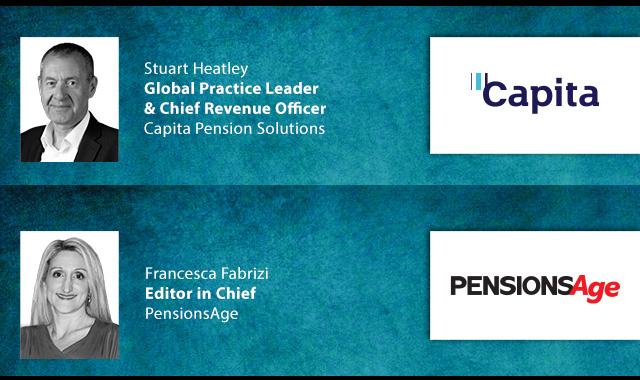
In the latest Pensions Age podcast, Francesca Fabrizi speaks to Capita Pension Solutions global practice leader & chief revenue officer, Stuart Heatley, about who matters most in pensions and how to best meet their needs


© 2019 Perspective Publishing Privacy & Cookies
Recent Stories